



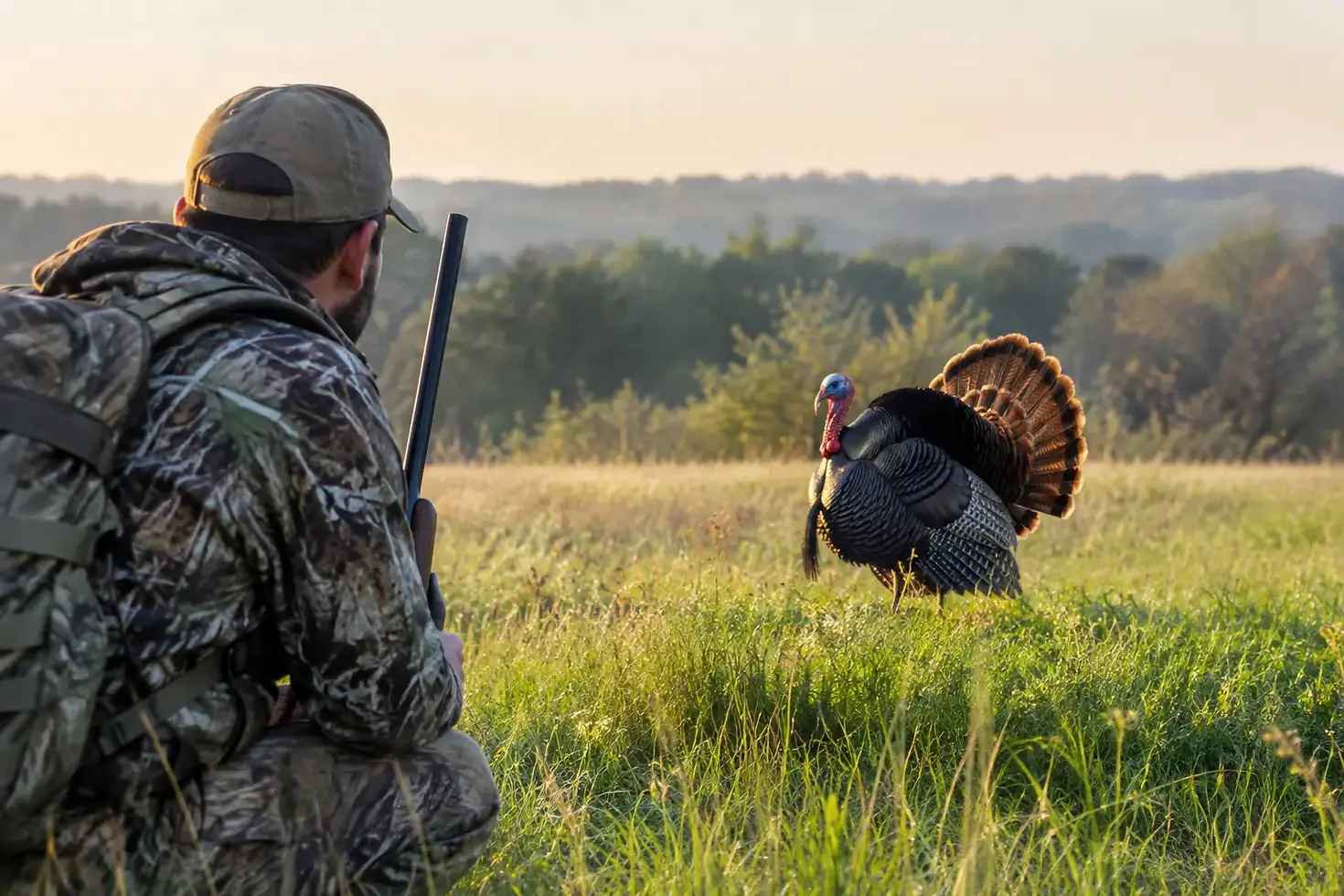
10 Top Turkey Hunting Mistakes to Avoid This Spring

A spring gobbler can sound like he is coming on a string, then go quiet 70 yards short of your gun barrel. That is often where the top turkey hunting mistakes show up. The bird did not vanish. He likely hung up because something in the setup, the calling, or the hunter's movement gave him a reason to stop.
Turkey hunting is a close-range game built on details. Good ground and plenty of birds help, but they do not replace sound decisions when a gobbler is working. Whether you are hunting familiar Missouri timber or traveling for a few days of spring hunting, avoid these mistakes and give yourself more chances to finish a hunt cleanly.
1. Setting Up Where You Cannot Kill the Bird
The biggest calling mistake is often not calling at all. It is sitting down in the wrong place after you call. A gobbler may answer from 100 yards away, but that does not mean he will walk straight to the tree where you are sitting.
Turkeys use terrain, field edges, logging roads, creek crossings, and open timber in predictable ways. A bird may prefer to stay on a ridge top, follow a field boundary, or avoid crossing a steep draw. If you set up on the opposite side of an obstacle, he may gobble for an hour without taking the final steps.
Before calling, look at the ground between you and the bird. Choose a spot with a clear shooting lane and enough open ground that he can see the hen he expects to find. Set up 20 to 30 yards back from the edge of that opening when possible. Sitting directly on the field edge often leaves you too exposed and gives a hung-up gobbler an easy view of empty ground.
Let the Turkey Have the Advantage He Expects
A mature tom usually wants the hen to come to him. Your setup must account for that natural tendency. If he is above you on a ridge, consider moving to a position where he can approach on level ground. If he is in a field, calling from inside the timber near a likely entry point can be better than challenging him from the middle of the open.
2. Calling Too Much When the Bird Is Already Interested
A gobble is exciting, especially when the morning is quiet. Many hunters answer every gobble with a full series of yelps, cuts, and purrs. That can work on an aggressive bird, but it also tells an older gobbler exactly where you are without giving him a reason to commit.
Start with enough calling to let him know a hen is available. Then listen. If he answers and closes distance, ease off. A few soft yelps or quiet clucks may be all you need. Silence can be a stronger tool than another loud call when he is looking for the source.
This does not mean every turkey should be called softly. Windy mornings, birds across wide fields, and heavily vocal flocks may require more volume. The mistake is using one calling style for every situation. Match the call to the distance, terrain, weather, and bird's attitude.
3. Moving Before You Know Where the Gobbler Is
Turkeys see movement better than most hunters realize. A quick turn of the head, a hand reaching for a call, or a gun barrel shifting at the wrong moment can end the hunt. The danger increases when a gobbler goes silent. Hunters often assume he left, stand up, and find out he was standing just inside the timber.
When a bird stops gobbling, stay put longer than feels comfortable. He may be walking quietly, checking the area, or waiting for the hen to reveal herself. Scan slowly with your eyes, not your whole upper body. Keep your shotgun or turkey gun pointed toward the most likely approach before the bird arrives.
If you need to reposition, do it only after you have a clear reason. Maybe the gobbler is pinned across a creek, has drifted away with hens, or is consistently answering from a location he will not leave. A planned move is part of turkey hunting. A frustrated move usually creates noise, movement, and a bumped bird.
4. Ignoring the Roost-to-Ground Transition
Many hunters hear a bird gobbling hard from the roost, call aggressively, and expect him to fly down at their feet. Sometimes that happens. More often, a tom flies down toward hens, a strut zone, or the route he has used for several mornings.
Roosting birds is valuable, but knowing where they want to go after fly-down is even better. Scout for droppings, feathers, scratched leaves, tracks in soft ground, and consistent travel routes. Listen from a distance in the evening, then return well before daylight without crowding the roost tree.
Avoid walking directly under a roosted bird. It may seem like the best way to get close, but a snapped stick or a silhouette against the sky can send him to another ridge before shooting light. Set up close enough to work him, yet far enough away that you can move into position quietly in the dark.
5. Hunting Only the First Two Hours
Early mornings are prime time, but quitting after breakfast is one of the most common turkey hunting mistakes. A gobbler that has hens at daylight may become far more willing by midmorning. Hens often head to nests late in the morning, leaving the tom alone and searching.
From roughly 9 a.m. through noon, cover ground carefully and call at likely places. Field corners, ridge points, old logging roads, creek crossings, and open hardwood pockets are all worth attention. Call, wait, and listen. Midday birds may not gobble as often as birds on the roost, but a lonely tom can come in quietly and quickly.
This is where good preparation matters on a destination hunt. When you have several productive areas and understand how birds move through timber, fields, and rolling ground, you can make a smart adjustment instead of simply waiting in a spot that went cold.
6. Overlooking the Wind and Your Approach Route
Turkeys do not rely on scent the way deer do, but wind still matters. A hard wind limits how far you can hear a gobble, makes calling difficult to locate, and keeps birds from using exposed areas. It also covers the sound of a turkey walking in, which means a bird can appear close without warning.
On windy days, hunt sheltered sides of ridges, protected timber, draws, and field edges out of the strongest gusts. Get tighter to areas where birds may loaf or feed. Use natural terrain to reduce the noise you make while walking and to improve your ability to hear.
Your approach also matters after a bird responds. Do not march directly toward every gobble. Use the terrain to close distance without exposing yourself, and stop before you enter the zone where a turkey may spot movement. A patient, quiet approach gets more chances than trying to force a fast setup.
7. Sitting With Poor Concealment
Full camouflage does not fix a bad backdrop. A turkey's sharp eyes pick up human outlines, especially a head and shoulders against open woods. Sit against a large tree that breaks up your shape, clear small sticks and leaves that may interfere with your gun, and keep shadows working in your favor.
Make sure you can see in the direction a turkey is likely to approach. It is no help to be hidden perfectly if brush blocks your shot until the bird is standing five yards away. At the same time, avoid setting up in a wide-open spot where he can spot you from 100 yards. The best setups balance concealment with a clean, ethical shooting lane.
8. Forgetting That Hens Control the Morning
A gobbler with hens is not necessarily a bird you cannot kill. He is simply a bird working on a different schedule. Calling harder at him may pull a hen closer, and that may bring the tom along. Or it may convince the flock that something is not right.
Listen to the hens. If they are vocal, answer their rhythm without trying to outdo them. If the flock is drifting away, do not chase blindly. Mark the direction, back out when you can, and make a plan for where they may feed, travel, or loaf later in the day.
9. Taking a Rushed or Unclear Shot
A close gobbler can make even experienced hunters hurry. Do not shoot at movement through brush, at a bird you cannot clearly identify, or at a turkey outside your practiced range. Wait until you have a clean view of the head and neck and know what is beyond the bird.
Pattern your shotgun before the season with the load and choke you will use. Know the distance where your pattern remains dependable, then hold yourself to it. A careful shot respects the bird and prevents a hard-earned opportunity from turning into a wounded turkey.
10. Treating Scouting Like an Opening-Week Chore
Fresh turkey sign changes quickly. Fields are planted, food sources shift, hens begin nesting, and pressure alters daily movement. Scouting once before the opener is useful, but continuing to scout is what keeps you on birds through the season.
Look for where turkeys were recently feeding and traveling, not just where they were last year. Pay attention to tracks, strut marks, droppings, dusting areas, and gobbling activity. A veteran guide can shorten that learning curve on unfamiliar ground, but hunters still benefit from watching, listening, and asking the right questions.
At Missouri Outfitters MCCO, the goal is straightforward: give hunters quality ground, practical guidance, and the room to hunt without the feel of an overcrowded camp. The final part still belongs to the hunter who stays patient when a gobbler goes quiet, trusts the setup, and is ready when the bird finally steps into the open.


Comments